Resources & Support: Child Care, Early Education, and Immigration
This technical assistance and resource hub is for child care and early education providers, advocates, implementers, decisionmakers, and national and state partners. It includes a recorded training, guides, talking points, and other materials to support child care and early education advocates and providers continuing to navigate the challenges ahead. Below you can find:
On this Page:
- A recorded training of the March 2026 webinar “How to Protect Early Childhood Programs from Immigration Raids”
- Our Safe Spaces Guide (available in English and Spanish), last updated in March 2026
- A printout poster on our Safe Spaces Guide
- Immigrant eligibility information for early childhood programs, last updated in June 2026
- Information on parental rights, last updated in November 2025
- Mental health support and safety planning
Since its 2007 report highlighting the experiences of immigrant families in child care and early education, CLASP has worked at the intersection of immigration and child care and early education. This work escalated in 2017, when attacks on immigrants intensified. In response, CLASP researchers examined how anti-immigrant policies and rhetoric were affecting young children across six states, documenting the harm in a series of reports. In 2019, CLASP published the first version of the Safe Spaces Guide, designed to inform providers of their rights under the protected areas policy.
On the first day of Trump’s second term, the administration rescinded the protected areas guidance, removing limits to immigration enforcement in previously protected areas like schools, hospitals, and child care settings. CLASP responded by updating our Safe Spaces Guide to reflect these changes and to remind providers of steps they can take to keep themselves safe using constitutional rights and protections.
Further, building on our work documenting harm in the first Trump Administration, from 2025 to 2026, parents and early care and education providers across the country shared how the political environment–especially the increase in anti-immigrant policies, practices, and rhetoric–is harming their physical and mental health, their income and stability, and the well-being of the young children in their care.
We hope that this page is helpful, and we thank you for the hard work you do to care for, advocate for, and support children and families.
CLASP is Available to Support You!
We understand that every question may not be answered by the content on this page. If that is the case, please fill out this Google form and we will reach out with more information. We can provide support on initiatives at the intersection of immigration and child care and early education like:
- Requests for presentations on creating safe space guides
- Reviewing safe space guides
- Questions on immigrant eligibility for federal child care programs
- Questions on the rights of immigrant parents
- And more!
Request technical assistance
Share a few details about your request and the CLASP team will follow up with you directly.
Recorded Training
CLASP Training on How to Keep Early Childhood Programs Safe from Immigration Raids
In March 2026, CLASP hosted a webinar for child care and early education providers to learn how to protect their programs from immigration raids. We covered the impact of immigration policies on access to early childhood programs, including the removal of the protected areas/sensitive locations policy, and strategies for ensuring immigrant families feel safe in facilities and programs.
Safe Spaces Guide
CLASP Safe Spaces Guide
“A Guide to Creating ‘Safe Space’ Policies for Early Childhood Programs” gives early care and education providers, advocates, and policymakers information and resources to design and implement “safe space” policies that safeguard early childhood programs against immigration enforcement. A “safe space” policy is a plan or set of protocols that seeks to mitigate the harm of possible immigration enforcement actions at or near early childhood programs. The policy is intended to protect the safety and privacy of staff and families at your facility. CLASP is available to provide technical assistance as you develop your safe space policy.

“A Guide to Creating ‘Safe Space’ Policies for Early Childhood Programs”
The full guide for early childhood providers and advocates—including how to build a safe space policy and how to tell a judicial warrant from an administrative one. Updated March 2026.
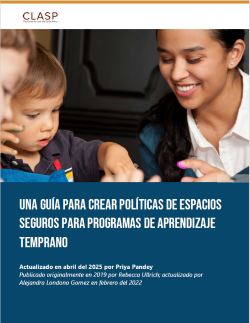
“Una Guía para Crear Políticas de ‘Espacios Seguros’ para Programas de Aprendizaje Temprano”
La versión en español de la Guía de Espacios Seguros para programas de aprendizaje temprano.
Printout Poster
Safe Spaces Poster
If you’d like a handy printout of our safe spaces guide, we have created this one-pager that can be printed as a poster to display or a flyer to distribute to staff.
Eligibility
Immigrant Eligibility Briefs
“Immigrant Eligibility for Federal Child Care and Early Education Programs” gives child care and early education providers, advocates, and parents information and resources to support understanding of eligibility for programs like Head Start and CCDBG-funded child care. This resource has been updated from CLASP’s 2017 version to account for immigration policy changes. The accompanying blog “Understanding Immigrant Eligibility for Child Care and Early Education Programs” expands the current context surrounding immigrant eligibility and the attacks from the Trump Administration on immigrant families. Immigrant families and those who support them can use both resources to better understand eligibility for federal child care programs and how the current political environment is affecting programs.
Public Charge & Early Childhood Education Fact Sheet
In July and August 2026, the Department of Homeland Security published a new public charge rule and subsequent guidance that could impact immigrant families’ access to basic needs and education programs. The final rule became effective on September 18; this resource details what early childhood partners and the child advocacy community need to know.
Parental Rights
Detained Parents Directive
Parents may come to you with questions on what they should do if they are detained by Immigration and Customs Enforcement (ICE) agents. It is important for providers supporting parents who are preparing for possible deportation to know about the policy and the protections they should demand from ICE if they are detained. Parents have a right to make decisions about the care and safety of their children, even while in ICE custody. Under its own policies, ICE has a responsibility to ensure that detained parents have a say in the care of their children and how to keep them safe. CLASP and the National Immigration Law Center have created the following resource, available in multiple languages, that explains what parents should know about the policy. We recommend having these available to distribute or share at your center to parents or staff who may need it:
Mental Health & Safety Planning
Love Letter to Immigrant Parents
In partnership with the National Parents Union, Little Justice Leaders, and United Parent Leaders Action Network, the Children Thrive Action Network and advocates have published “A Love Letter and Support Guide for Families Navigating Harmful Immigration Raids and Policies.” This guide was created for immigrant parents and shaped by the insights and experiences of families impacted by immigration enforcement throughout the country.
The guide highlights their experiences and offers advice, providing parents with mental health resources for themselves and their children. This love letter to immigrant parents invites parents to reflect on their own mental health, guides them through safety planning, and offers tips on how to talk to and support their children that may also be helpful for child care and early education providers. We recommend sharing this with parents who ask for resources on supporting their well-being and their children, and safety planning.

“A Love Letter and Support Guide for Families” — English
Mental health reflection, safety planning, and tips for talking with and supporting children.

“Carta de Amor y Guía de Apoyo para Familias” — Español
Reflexión sobre la salud mental, planificación de seguridad y consejos para las familias.