CLASP
The Center for Law and Social Policy
By Kaelin Rapport, Ph.D. and Elyse Shaw
Note: this post originally appeared on Medium.
In mid-June, the Department of Justice (DOJ) released a memo calling for states to ignore the integration mandates embedded in Section 504 of the Rehabilitation Act of 1973, Title II of the Americans with Disabilities Act, and the Supreme Court’s ruling in the Olmstead case. These policies and cases are bound together by a desire to end the history of discrimination experienced by individuals with disabilities because of their condition and to provide access to in-home and community-based health services and educational accommodations. However, the crux of the DOJ’s memo is an attempt to undermine the needs of individuals with disabilities by reinterpreting the responsibilities of federal and local governments when administering accessible services in an ‘integrated’ setting.
Wide adoption of the memo’s provisions would be especially devastating for students with disabilities. Elyse Shaw’s experiences accessing and maintaining care for her child demonstrates how the system in place already fails to meet the needs of many students and their families.
The millions of children who qualify for and receive accommodations through section 504, from kindergarten to grade 12, are entitled to a “504 plan,” which includes accommodations such as extra time for testing and assignments, and access to sensory breaks and fidgets. Through the Individuals with Disabilities Education Act, students may also qualify for anindividual education program, or IEP, which has additional accommodations like one-on-one support or an aide, and comes with more stringent reporting requirements for schools. Both plans are tailored around an individual’s unique needs and ensure integration in the school and curriculum. But 504 and IEP plans are often aspirational. The shortfalls are generally not the fault of the teachers and staff who work tirelessly to provide these services, but the result of administrative obstacles and public school budget cuts that result in staffing shortages and reduced oversight on plan implementation.
When she tried to get an assessment for her child through the public school system, Elyse was told to expect a six- to eight-month wait. She could get a private assessment sooner, but that would cost more than $3,000 out-of-pocket if her health insurance plan didn’t cover the cost. Even with health insurance and private assessments, it still took a year and half to get an accurate diagnosis, which was just the first step in getting a 504 plan.
Even with a 504 plan in place, Elyse still spends countless hours on emails and meetings every year to make certain her child is getting the services she needs.
The accommodations her child receives, even with the system’s flaws, enable her to continue learning and progressing at grade level alongside her peers. The plan ensures that there is at least one paid professional at the school — even though it is understaffed and under-resourced — who works alongside parents to make sure children’s accommodations change and grow with them.
Without the 504 plan and a job with the flexibility to take time to address these care needs, it’s likely that Elyse’s child would be in a specialized school, segregated and isolated, with no accountability measures to make sure she is protected, safe, and given the same rights as her non-disabled peers.
Creating the Conditions for Re-Institutionalization
Many are not so lucky. Almost half of the students with disabilities that require accommodations go without, and a significant portion of those students feel that they need more support.
Without the assistance needed to thrive, they are punished more consistently than their peers. Children with disabilities comprise roughly a quarter of the children given an out-of-school suspension. The consequences of this access gap are further accelerated by race; non-white students, and Black students in particular, suffer harsh disciplinary actions in schools at disproportionate rates and are more likely to have their 504 or IEP accommodations mishandled.
At best, the DOJ’s move to reduce states’ responsibility to facilitate integration for individuals with disabilities could lay the groundwork for school segregation. At worst, the reinterpretation of the integration mandate will channel students with disabilities into the school-to-prison pipeline. The majority of children already swept into the juvenile detention system have disabilities that make them eligible for special education services, and yet only 37 percent received those services while in school.
To understand the Trump Administration’s likely solution to the integration problem, we can look to the proposed plan of building a forced treatment camp in Utah for individuals dealing with mental health challenges. Rather than provide services for individuals with disabilities in a home or community-based setting, they could be forced to go without their accessibility and health care needs met or isolate themselves within a presumably better resourced institution–if they can afford transportation and tuition.
What Is to Be Done?
Weaponizing the ambiguity surrounding state responsibility to accommodate the needs of people with disabilities is the latest in a series of attacks launched by the administration to shrink the federal government’s social safety net. This time, the consequences facilitate the conditions for segregation and mass institutionalization.
To protect children and students with disabilities, we must intentionally reckon with the past in ways that put students with disabilities first and include them in decision-making processes. That will require the commitment of states and education systems to building the infrastructure necessary for resourced, community-based care systems. We also need these systems to holistically define and expand the integration mandate.
Doing this will require states and school districts to hire more specialized staff for all schools, especially staff with the training and expertise to provide assessments, diagnosis, and tailored social, emotional, and academic support. Additional training for all teachers on how to properly adhere to and implement 504s and IEPs is also needed.
Finally, we recommend that codes of conduct and training be developed and disseminated for the implementation of 504 and IEP plans that acknowledge racial stereotypes and their impact on how individual school administrators, teachers, and support staff interact with and discipline students. Without these provisions, the most vulnerable of our students will be shut out or left behind, just like their predecessors.
Washington, D.C., September 15, 2026—Today’s release of the U.S. Census Bureau’s national Income, Poverty, and Health Insurance data for 2025 may be the last year of positive impact, as the prior administration’s policy choices taper off. Despite this, enormous income inequality persists.
In 2025, median household income increased 2.6 percent, to $87,460. Median earnings for women also increased by 3.2 percent; they now make 84 percent of what their male counterparts are paid. And 92.1 percent of the U.S. population had health insurance for at least some part of last year.
While these numbers may not seem concerning, a closer look reveals troubling trends and worrying indicators for future years. The median income didn’t rise enough to cover today’s inflation; indeed, when accounting for the effect of inflation in 2026, median income only rose less than one percentage point.
When income doesn’t keep up with inflation, the individuals and families most affected are those earning the least amount of money. This demographic is also disproportionately affected by the many provisions in H.R.1, which passed in July 2025, and that will further jeopardize economic security. We will not see the true impact of these provisions until next year’s numbers are released and as elements of these policies take full effect, but an estimated 4.5 million people lost SNAP coverage between July 2025 and May 2026, including approximately 1.5 million children.
Today’s data also showed that nearly eight million people were pushed into poverty due to health expenses. With millions more expected to lose Medicaid coverage because of H.R.1, the number of people who enter poverty due to higher out-of-pocket health care costs will also increase in the coming years.
“Many of the policies enacted in July 2025 through H.R.1 are on a long fuse, with just some of the massive cuts taking effect last year and many more on tap in the coming years. This means that the numbers we see today will only get worse in the future, including for children, women, immigrants, and people of color. We’re especially concerned about immigrants whose ability to work and access care without fear of immigration enforcement has already severely impacted their daily lives and economic security,” said Wendy Chun-Hoon, executive director of the Center for Law and Social Policy.
The persistent gender wage gap is also a nagging indicator. While that gap narrowed in 2025, likely due to the beneficial polices of the previous administration, women’s wages only moved closer to men’s by three cents. Such a slight increase will not move the needle on income inequality.
Overall, today’s data can be seen as setting the baseline for the harmful policies hardwired to play out in the coming years. And even at this baseline, we can see that people are not moving out of poverty—they are holding steady. While we are relieved that the news is not worse, we recognize that the affordability crisis and impending cuts to programs families rely on will increase income inequality, widen the wealth and gender wage gaps, and push more Americans into economic precarity and poverty.
“As the affordability crisis deepens, so does the country’s wealth gap. H.R.1’s tax cuts for the wealthy were largely funded by draconian cuts to programs that support people with lower incomes. As a result, we expect to see income inequality rise even more in the coming years, as income soars for the wealthy while working families will see lower incomes and continued challenges with affording the groceries, rent, and other things they need for to survive—and thrive,” said Chun-Hoon.
By Amienata Fatajo
This brief explores which groups are most impacted by public benefit restrictions, how benefit restrictions influence behavior, and why reduced access to food and health care creates both short- and long-term health inequities. Immigrants are one of the major groups who are impacted by those restrictions. Fear of deportation and administrative burdens, as well as eligibility restrictions, limit access to food and health care. These restrictions shape behavior, cause people to avoid essential services for which they are eligible and ultimately worsen public health outcomes and inequities across communities.
The following statement can be attributed to Wendy Chun-Hoon, president and executive director of the Center for Law and Social Policy (CLASP)
Washington, D.C., August 19, 2026—On September 15, the U.S. Census Bureau will release reports with national data on Income, Poverty, and Health Insurance for 2025. While we anticipate a slight rise in poverty across the board compared to the data from 2024, we know that next month’s numbers will serve as a bellwether for what’s coming.
The changes wrought by H.R.1, signed into law by President Trump in July 2025, are already taking effect in communities across the country. For example, Congress let the Affordable Care Act (ACA) tax credits expire last December when it passed H.R.1, pushing nearly three million people off their health insurance in early 2026. While the 2025 data don’t yet capture this drop in access to affordable health insurance for millions, we know that individuals and families are desperately struggling to pay for health care.
We should anticipate a rise in poverty for women, higher poverty for children of all races, and more poverty among immigrants, all driven by the many provisions in H.R.1 that are destabilizing families, such as the elimination of more than $200 billion in basic food assistance over the next decade. SNAP work requirements have also been tightened for elderly people and people with disabilities. Already, between October 2025 and February 2026, we’ve seen WIC participation decline by 250,000 people.
The administration’s relentless attacks on immigrants and their families will continue to have a chilling effect on access to the public benefit programs they are eligible for. This includes policymakers imposing significant eligibility restrictions on Medicaid, ACA, and SNAP for immigrants authorized to be in the U.S. In addition, immigration enforcement has created conditions in which workers lose wages and can fall into poverty if they stay home due to fear of ICE officers at workplaces.
While the administration and Congressional leaders have targeted immigrants in their slashing of social safety net programs, populations across the country are seeing their Medicaid, food assistance, and child care assistance gutted at the federal level in favor of funding military actions and aggressive immigration enforcement. We also know that last fall’s longest-ever government shutdown—a crisis manufactured by the White House and Congress—pushed countless people to the economic brink. Moreover, millions are living with the consequences of policy choices that have driven up inflation, driven down wages, and reduced funding for programs that meet basic needs. As a result, far too many people are taking on debt just to buy groceries and pay for the gas they need to commute to work.
We expect the September reports will show a wider gender pay gap and a rise in income inequality for Black households relative to white households. This phenomenon is largely driven by the disproportionate job losses experienced by Black women and the fact that it took Black women twice as long to find a job as white women in the second half of 2025. After attaining employment, Black women are paid less than their white peers, regardless of their educational level.
The Census reports will be much more than a look-back at the state of the country in 2025. Sadly, they will be a preview of the harm ahead for our communities because policymakers have chosen to enrich the wealthiest and finance a siege on immigrants over helping people meet their most basic, human needs. Poverty is the result of systemic failures, and our nation and the people who show up every day to make our economy work deserve better.
Excerpt:
But some experts fear the accounts will further solidify the nation’s wealth gap as more well-off parents contribute to their children’s accounts while those in low-income households are unable to fund them. Others caution that, as an investment, Trump Accounts are not the best option for parents looking to give their children a financial leg up at age 18.…
Giving charitable donations to families who don’t need them is troubling as it comes when inflation is high, and the administration is slashing funding for social services and other supports that many families rely on, said Ashley Burnside, senior policy analyst at the Center for Law and Social Policy in Washington, D.C.
“They’ve made dramatic cuts to Medicaid, to SNAP,” Burnside said, referencing federal programs that provide health insurance and help purchasing food. “If a parent can’t afford groceries each month, it’s going to be very unlikely that they ‘re going to be able to put money away towards a child’s account or towards college savings.”
Orlando Sentinel subscribers can read the full article here.
Note: This article also appeared in the Denver Gazette in CO; The Herald Enquirer in NC; Lancaster Online in PA; Sun-Sentinel in FL; CPA Practice Advisor; and Daily Gazette in NY.
Excerpt:
“We are seeing a trend around the administration scapegoating immigrants and not pointing to the actual bad actors: corporations,” said Isha Weerasinghe, director of the public benefits justice team at the Center for Law and Social Policy, a Washington-based nonprofit that advocates for people with low incomes.
…
Weerasinghe said that the administration is using a well-worn tactic of blaming marginalized groups to take away benefits from the population more broadly.
“All of us know about the ‘welfare queen’ narrative, and that worked,” said Weerasinghe, referencing a racist trope popularized by Ronald Reagan to characterize Black people on benefits as greedy fraudsters. “It created a lot of hatred toward public benefits, and also this willingness for the public to be OK with this kind of crackdown that was absolutely unnecessary.”
Read the full article in The Intercept here.
Co-authored by Georgetown University Center for Children and Families, Center for Law and Social Policy, National Association for the Education of Young Children, and National Association for Family Child Care
[Editor’s Note: Last Updated July 22, 2026]
Medicaid is an important source of health coverage for the early childhood education professionals who support child development and care for children while parents work, and for the children and families these educators serve. Twelve states cover a third or more of the child care workforce through Medicaid, making the program an essential part of ensuring the health and well-being of child care professionals. In turn, a healthy early childhood workforce can most effectively support the positive development of children in their earliest years. Threats to Medicaid coverage for early childhood educators would likely further deepen a child care crisis driven in large part by inadequate compensation for this critical workforce. To address the root of this problem, the child care workforce needs higher wages and access to quality benefits which requires significant, robust, and sustainable public investments. Until this core problem is addressed, many workers necessarily rely on Medicaid and SNAP.
Read the report on the Georgetown Center for Children and Families’ website here.
This statement can be attributed to Wendy Chun-Hoon, president and executive director of the Center for Law and Social Policy (CLASP)
Washington, D.C., July 2, 2026–July 4th will mark one year since Congress passed and Donald Trump signed into law the Budget Reconciliation Act of 2025. Also known as H.R.1, the bill included the largest cuts to Medicaid and SNAP in the programs’ histories and prioritized funding to separate immigrant families and give tax breaks to the wealthy. As families continue to deal with the rising costs of living, they are now also left without health care and food assistance.
H.R.1 slashed nearly a trillion dollars from Medicaid and Affordable Care Act Marketplace tax credits. More than 1 million people have dropped Marketplace coverage and more than 10 million are projected to lose Medicaid coverage over the next decade. The bill’s impact on food assistance is already being felt, as SNAP participation has declined in every state since H.R.1 became law. Based on the latest available data, SNAP participation has fallen by more than 4 million people, or roughly 10 percent; and in the 12 states with available child-level data, more than 700,000 children have lost SNAP food assistance–all because the majority in Congress and the administration prioritized billionaires over families. We expect these harms to grow as states fully implement new eligibility restrictions and other measures in response to future state cost-sharing requirements.
These numbers do not reflect a decline in hunger or reduction in poverty. They represent millions of families who continue to struggle with medical bills, rising food costs, and economic hardship but are now being pushed out of the very programs designed to help them. And people who are technically eligible to keep Medicaid or food assistance will face significant new paperwork barriers, including more frequent Medicaid renewals that will make it harder to access the benefits they qualify for.
H.R.1 provided $170.7 billion in additional funding for immigration enforcement to the Department of Homeland Security (DHS) and carved out lawfully present immigrants from basic needs programs. This historic ballooning of immigration enforcement funding has turbocharged family separations and child and family detention, threatening child safety and well-being. An estimated 205,000 children,145,000 of whom are U.S. citizens, have experienced having a parent in detention. To make matters worse, these U.S. citizen children are also likely among those who are now losing access to the Child Tax Credit, at a time when they and their families are in most need of support. These changes will increase child poverty; and, building on the exclusions from the 2017 tax reforms that excluded eligibility for children without a Social Security number, affect nearly 4 million children. Moreover, the high level of disenrollment in SNAP and Medicaid is in part due to H.R.1’s exclusion of lawfully present immigrants, such as asylum seekers and refugees, as well as the chilling effect on people whose children are likely eligible but are disenrolling because they are concerned about their participation being used against them in immigration proceedings.
The DHS funding granted through H.R.1 is enabling immigration actions that are actively endangering our nation’s children. At least 79 children have been tear gassed or pepper sprayed and over 6,200 children have seen the inside of an immigration detention camp, where they experienced disruptions to their education, poor nutrition, and delayed medical care. The fear and uncertainty is affecting not only the children directly impacted by these policies, but also their classmates, teachers, and neighbors. The harms of H.R.1 will reverberate for generations.
Policymakers should invest in policies that support family unity and actually center community well-being, such as community-led food systems that keep families fed, regardless of political shifts. Congress must rescind the harm caused by H.R.1 and restore access to health coverage, food assistance, and economic supports. Repairing this harm will require that Congress moves away from policies rooted in suspicion, punishment, and unsupported fraud narratives and instead advance policies grounded in evidence, dignity, and the realities families face.
By Suzanne Wikle
The first year and a half of Trump’s second term and the 119th Congress makes it very clear that policymakers are waging a wholesale attack on people’s ability to afford health care – a basic human right that everyone should have. Republicans’ assault on health care goes far beyond the $1 trillion they cut from Medicaid and ACA last year as part of H.R.1, the Budget Reconciliation Act of 2025.
The Republican-led H.R.1 is estimated to cause nearly 17 million people to lose their health insurance in the next decade, in large part because of new Medicaid eligibility requirements forcing people to prove they are working, volunteering, or exempt from the requirements. Last week, the Centers for Medicare and Medicaid Services (CMS) released an interim final rule to states about implementation details. As pointed out by 48 patient advocacy groups, the guidance goes against promises made by Congressional Republicans and makes it harder for people who are “medically frail” to stay eligible for Medicaid.
Prior to the rule being published, states were under the impression from CMS that they would be able to use existing data to identify someone as medically frail (e.g., someone with a cancer diagnosis). Under the published rule, people will now have to prove that a medical condition “significantly impairs” their ability to work. This will be incredibly burdensome for individuals and increase the workload of state eligibility workers. The administration didn’t have to do this and could have made it easier for people with cancer diagnoses or other illnesses to remain eligible for Medicaid. But administration officials went out of their way to write the rules in a way that will cause more people to lose their health insurance.
States are starting to speak up about the cost to implement H.R.1’s Medicaid changes. In addition to taking health care away from millions of people, states are on the hook for tens of millions of dollars to change computer systems and hire new eligibility staff. The Trump Administration is adding to state budget woes by again going beyond what H.R.1 required in terms of financing changes related to State Directed Payments – a wonky but important way federal dollars flow to states to keep Medicaid programs afloat. H.R.1 cut these funds to states and then CMS released guidance last month that will triple the financing cuts that were included in the legislation. If this stands in the final guidance, state budgets will face even greater Medicaid cuts, which will lead to even more people losing health care.
To add to the devasting cuts in H.R.1, CMS issued a proposed rule for insurers in the 2027 Marketplace. Once again, CMS continued its assault on people by significantly changing the rules to favor insurers and harm people. The proposed rule allows insurers to require people to pay more out of their pocket with higher deductibles and cost-sharing. Moreover, the rule would allow insurers to offer “no network” plans – literally putting the responsibility on people to ask their doctors if they will accept their insurance plan’s reimbursement rate. This is nothing but a giveaway to insurance companies and will undoubtedly lead to people paying more, delaying or forgoing health care, and likely taking on more medical debt.
Congress’s willingness to let enhanced subsidies for Marketplace insurance expire at the end of 2025 led to 1.2 million fewer people with insurance so far, and even more with lower tier plans that require more out-of-pocket costs and may have fewer benefits or more restrictive medication coverage. The recent actions by the Trump Administration will only add to the growing number of people who recently lost their health insurance.
The pattern is clear – at every opportunity and with every tool at its disposal, the Trump Administration is making it harder and more expensive for people to have health insurance and get the care they need. The full impact of H.R.1 and these proposed rules will take years to materialize, but there is no doubt that millions of people will lose their health insurance or have to pay more out of their pocket to use their insurance. It doesn’t have to be this way. We know that poverty a policy choice, but so is meeting people’s basic needs.
It’s clear that the current Congress and administration are intent on dismantling health care instead of solving the health care crisis in this country. CLASP will continue to work with partners to elevate the need for true solutions that live up to our belief that health care is a basic human right.
This event has already happened. Please see the full recording, learn more about the speakers, and find a list of resources below.
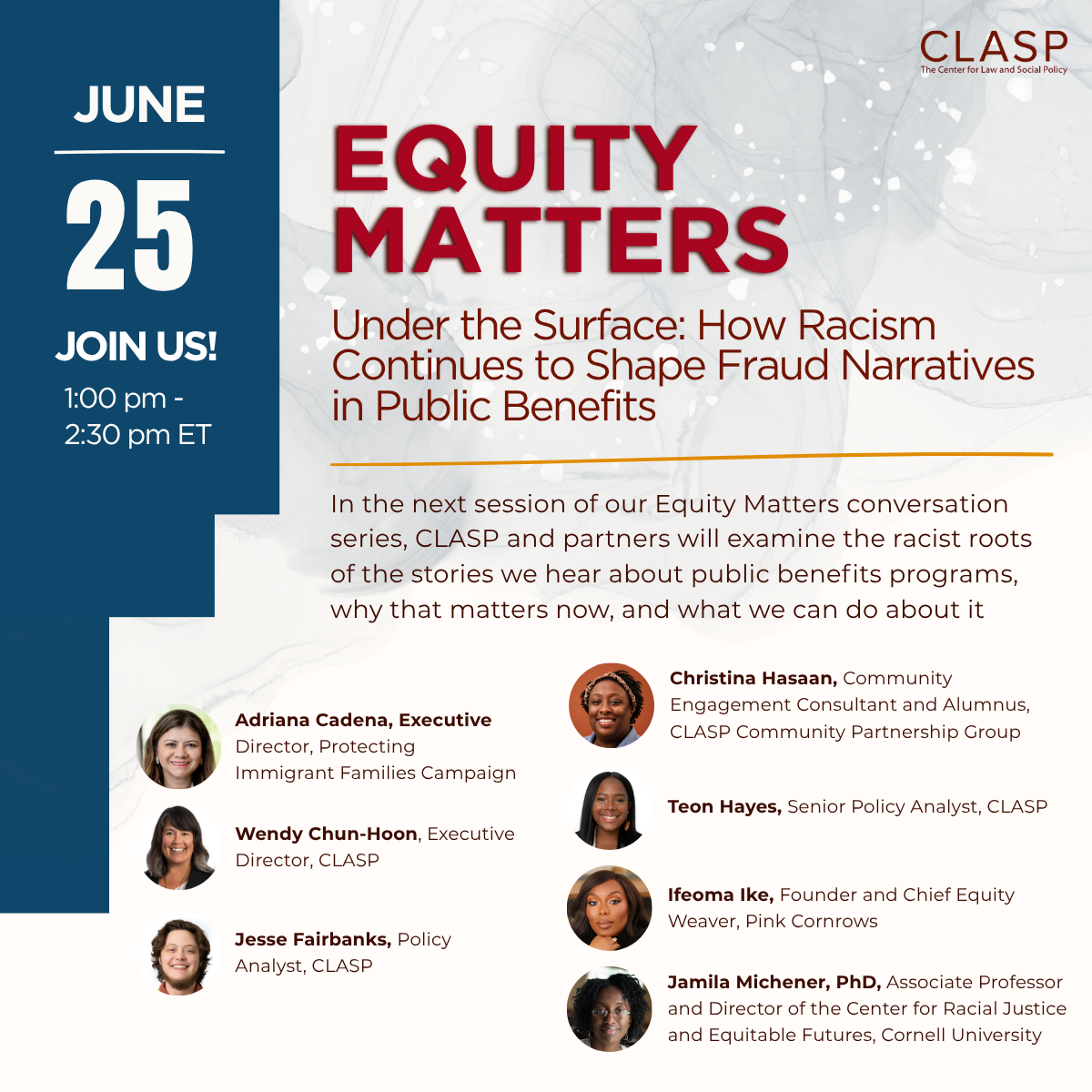
On June 25, 2026, the latest installment of CLASP’s Equity Matters series focused on how racism shapes fraud narratives of public benefits programs in the current public discourse. Our panel highlighted the history of racism in public benefits program administration, the ways that fraud narratives harm recipients, how policies have either exacerbated or refuted these narratives, and how advocates and lawmakers can support both public benefits recipients and administrators.
Watch the full recording below:
Speakers:
Framing
- Wendy Chun-Hoon, Executive Director, CLASP
- Jesse Fairbanks, Policy Analyst, Public Benefits Justice
- Teon Hayes, Senior Policy Analyst, Public Benefits Justice
Discussion
- Adriana Cadena, Executive Director, Protecting Immigrant Families Campaign
- Christina Hasaan, Community Engagement Consultant and Alumnus, CLASP Community Partnership Group
- Ifeoma Ike, Founder and Chief Equity Weaver, Pink Cornrows
- Jamila Michener, PhD, Associate Professor, Director of the Center for Racial Justice and Equitable Futures—Cornell University
- Parker Gilkesson Davis, Senior Policy Analyst, CLASP (moderator)
Resources from the Event
| Download Social Media Toolkit | Download Zine and Instructions |
| Download Slides | Download the Q/A Discussion |
| Download Fact Sheet | ➔ Subscribe for more Equity Matters Updates! |
|
Report A Community-Driven Anti-Racist Vision for SNAP This report offers recommendations for changes to the SNAP program that move it in an anti-racist direction. This includes examining issues around sufficiency; availability; trauma; trust; respect; promotion of opportunity; and the perspectives of participants. |
|
Testimony CLASP Testimony on the Racialized History of Fraud in SNAP Parker Gilkesson Davis, senior policy analyst on the public benefits justice team, shares her experience as a North Carolina caseworker around a paper she published analyzing the racialized history of fraud in SNAP. |
|
Report SNAP “Program Integrity:” How Racialized Fraud Provisions Criminalize Hunger CLASP takes on the racialized history behind SNAP fraud, details the significant damage caused by efforts to “rein in” this perceived problem, and offers policy recommendations for reversing the harm. |
|
Fact Sheet Five Ways State Agencies Can Support EBT Users at Risk of ‘Skimming’ Skimming is a crime that’s inconvenient and frustrating, regardless of who falls victim to it. But it is even more detrimental for people receiving SNAP and TANF who are living in poverty. |
|
Know Your Rights Know Your Rights about “Intentional Program Violations” If you’ve been accused of “fraud” in the SNAP program, this “Know Your Rights” factsheet may be helpful. |
|
Report Lifting Administrative Burdens to Advance Health and Racial Equity This paper from CLASP and the Center on Budget and Policy Priorities (CBPP) details the racist roots of administrative burdens in Medicaid, describes how these burdens continue to harm eligible people – particularly people of color – and provides specific recommendations for states to reduce administrative burden as a key strategy for advancing racial equity in Medicaid. |