CLASP
The Center for Law and Social Policy
By Teon Hayes and Jesse Fairbanks
Harmful and false narratives about people who use basic needs programs emerged in the 1900s and continue to influence policymaking to this day, including the idea of “welfare fraud.” Policymakers interested in limiting government spending have long alleged that basic needs programs are riddled with “fraud.” In their view, “fraud” is perpetrated by people with low incomes who “take advantage” of programs that are funded with taxpayer dollars. These policymakers claim that people who use basic needs programs simply “don’t want to work,” implying that a family can afford housing, child care, food, and health insurance just by working one minimum-wage job.
Fraud is the willful misrepresentation of facts for personal gain, and it’s most often committed by people with institutional power.
Recent policy changes that have been proposed to address “fraud” in basic needs programs include new eligibility restrictions, verification processes, work reporting requirements, performance metrics, and databases. Such proposals are dangerous and will lead to millions of eligible people losing their benefits. Layer upon layer of “anti-fraud” measures are redundant. Adding unnecessary procedural barriers to the application process makes accessing these programs a headache for everyday people. Proposals such as stricter verification processes are also expensive for states to implement, and they don’t prevent improper payments.
Improper payments are unintentional mistakes caused by agency processing errors, missing paperwork, or other miscommunications. They include both overpayments and underpayments.
There are three powerful beliefs at the root of narratives about widespread “fraud” in basic needs programs. Each one relies on antiquated, racist ideas of who does or doesn’t deserve help from the government to sustain itself.
Root 1 – Meritocracy and Individualism
Americans are taught that people with resources and wealth earned their money through hard work and sacrifice. This fantasy that any individual has the power to achieve economic mobility if they just “try hard enough” has led some to believe that people with low incomes can’t afford basic needs because of individual choices; therefore, no one deserves help from government. Poverty is the result of systemic failures outside of an individual’s control, like stagnant wages not keeping up with rising costs in an economy that views basic needs as a commodity rather than a public good. Structural barriers drive racial and other inequities in economic hardship. Examples of structural barriers include limited educational opportunities, discrimination in labor and housing markets, and over-policing of Black, brown and immigrant communities.
Root 2 – Racial Capitalism
The United States became a powerful capitalist country because of the unpaid labor of enslaved Africans. However, many Americans still hold racist assumptions about why Black people experience poverty at higher rates than white people. From the “Sambo” stereotype in early 1900s minstrel shows to the “welfare queen” on the news in the 1970s, racist narratives have long portrayed Black communities as more likely to misuse public resources. Black people disproportionately experience poverty because the federal government failed to deliver reparations to formerly enslaved people, continued to discriminate against their descendants, and allowed people to terrorize Black communities. Black Americans were even excluded from America’s first basic needs programs, which created the white middle class.
Root 3 – Nativism and Colonialism
The United States expedited efforts to steal Indigenous land after it became an official country in 1776. Soon after, America developed its first immigration laws restricting citizenship to free white people, primarily to deny rights to Black and Indigenous people. America’s immigration policies over the past 250 years have continued to discriminate against people of color, justifying exclusions with false claims that immigrants will threaten people’s jobs and consume finite resources. Many Americans find this scarcity narrative compelling because it allows them to villainize and attack a group of people, rather than a system. Often immigrants have fled countries that faced destabilization because of intervention from countries in the West, like the United States. Immigrant communities enliven American culture and contribute significantly to the economy, all while being denied access to major basic needs programs.
Advancing a Progressive Narrative
Developing arguments that counter harmful dominant narratives requires us to treat the soil that nourishes American culture. We must counter individualist, racist, and nativist narratives about “fraud” in basic needs programs at the root.
Gardeners depend on a few different techniques to improve soil quality. One technique with roots in Indigenous cultures involves growing complementary crops that minimally compete for resources, known as intercropping. When done correctly, this practice can replenish the soil.
To popularize a progressive narrative about fraud and its impact on basic needs programs, as well as refocus America’s cultural priority on meeting people’s basic needs, we need to mix-and-match crops that appeal to different audiences. However, we can’t forget to plant the crops that are foundational to challenging the dominant narrative at its roots.
Aerate the Soil: Tell the Truth and Present an Alternative Worldview
These talking points challenge the belief that recipient-level “fraud” in basic needs programs is a relevant issue. Policymakers constructed this lie to sow public distrust in the programs. They scapegoat Black and immigrant communities to justify policy changes that hurt us all, including the middle class. But using billions of dollars to surveil benefit recipients won’t make groceries, housing, and gas affordable for everyday people. Instead, the government can invest tax dollars into public goods and services that help people afford their basic needs and achieve economic mobility. Every person deserves a stable home, food, and health care.
Fend Off Pests: Name Systemic Actors Committing Actual Fraud
These talking points narrow the public’s definition of fraud. The dominant narrative depends on an ambiguous definition of the term that incriminates people experiencing poverty. On the contrary, fraud is the act of obtaining something valuable through willful misrepresentation, and it’s committed by people with the institutional power to abuse government resources. Nearly 1,000 millionaires have not filed their tax returns and owe an estimated $34 billion in taxes. Health care companies commit millions in fraud through schemes like upcoding or unbundling every year. Wealthy people and corporations who avoid paying their taxes withhold critical revenue from our schools, libraries, and core
basic needs programs like Medicaid.
These talking points undermine the core argument that people with low incomes take advantage of basic needs programs. These programs can be challenging to navigate because of complicated rules and excessive paperwork requirements. In fact, so much documentation is required that eligible people are often deterred from applying. Because application and recertification processes are burdensome, people can unintentionally make mistakes. Adding more steps to the process may even lead to an increase in improper denials as state workers struggle to implement new rules. If the goal is to prevent application errors, policymakers should streamline programs by, for example, aligning eligibility criteria across programs so people can navigate them more easily.
This event has already happened. Please see the full recording, learn more about the speakers, and find a list of resources below.
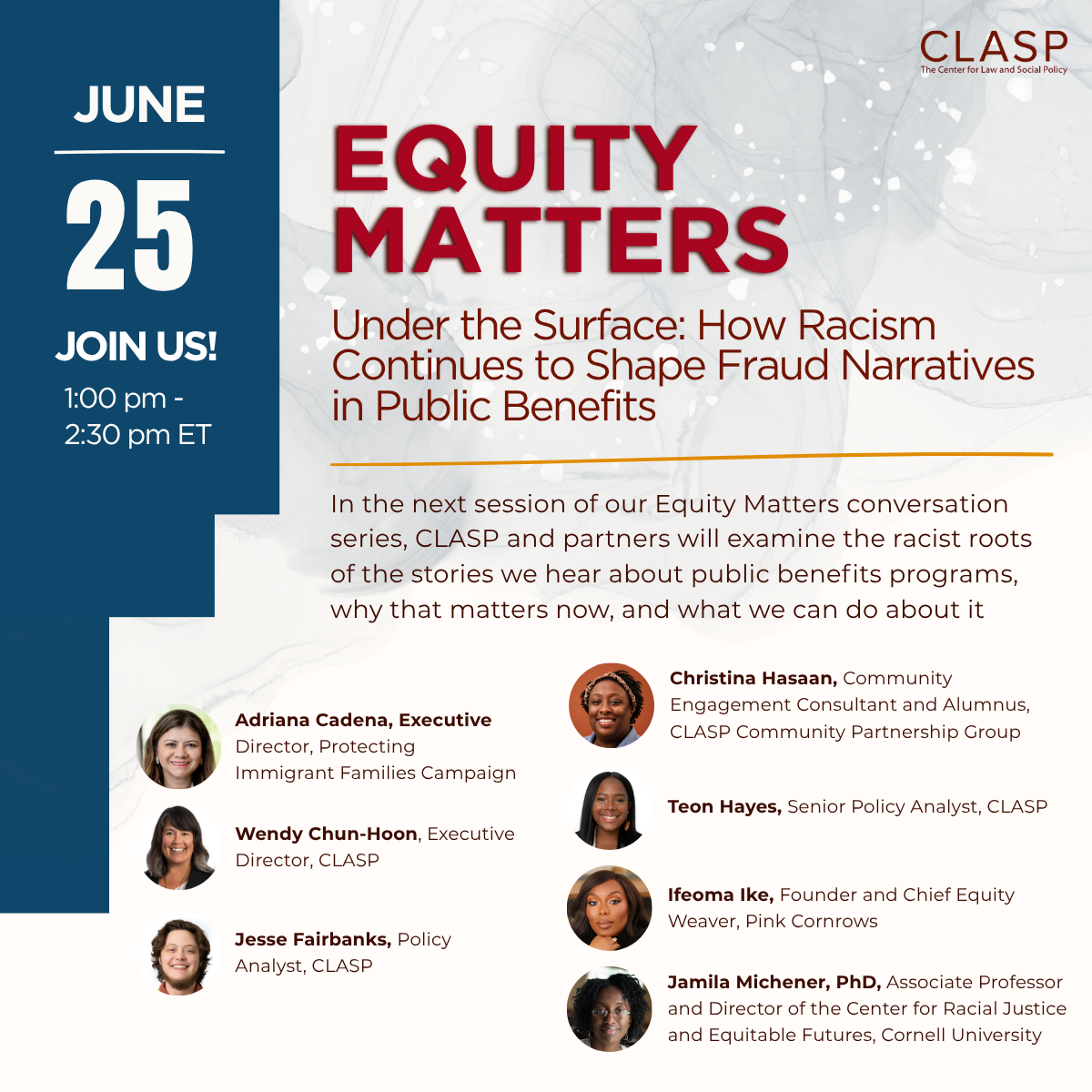
On June 25, 2026, the latest installment of CLASP’s Equity Matters series focused on how racism shapes fraud narratives of public benefits programs in the current public discourse. Our panel highlighted the history of racism in public benefits program administration, the ways that fraud narratives harm recipients, how policies have either exacerbated or refuted these narratives, and how advocates and lawmakers can support both public benefits recipients and administrators.
Watch the full recording below:
Speakers:
Framing
- Wendy Chun-Hoon, Executive Director, CLASP
- Jesse Fairbanks, Policy Analyst, Public Benefits Justice
- Teon Hayes, Senior Policy Analyst, Public Benefits Justice
Discussion
- Adriana Cadena, Executive Director, Protecting Immigrant Families Campaign
- Christina Hasaan, Community Engagement Consultant and Alumnus, CLASP Community Partnership Group
- Ifeoma Ike, Founder and Chief Equity Weaver, Pink Cornrows
- Jamila Michener, PhD, Associate Professor, Director of the Center for Racial Justice and Equitable Futures—Cornell University
- Parker Gilkesson Davis, Senior Policy Analyst, CLASP (moderator)
Resources from the Event
| Download Social Media Toolkit | Download Zine and Instructions |
| Download Slides | Download the Q/A Discussion |
| Download Fact Sheet | ➔ Subscribe for more Equity Matters Updates! |
|
Report A Community-Driven Anti-Racist Vision for SNAP This report offers recommendations for changes to the SNAP program that move it in an anti-racist direction. This includes examining issues around sufficiency; availability; trauma; trust; respect; promotion of opportunity; and the perspectives of participants. |
|
Testimony CLASP Testimony on the Racialized History of Fraud in SNAP Parker Gilkesson Davis, senior policy analyst on the public benefits justice team, shares her experience as a North Carolina caseworker around a paper she published analyzing the racialized history of fraud in SNAP. |
|
Report SNAP “Program Integrity:” How Racialized Fraud Provisions Criminalize Hunger CLASP takes on the racialized history behind SNAP fraud, details the significant damage caused by efforts to “rein in” this perceived problem, and offers policy recommendations for reversing the harm. |
|
Fact Sheet Five Ways State Agencies Can Support EBT Users at Risk of ‘Skimming’ Skimming is a crime that’s inconvenient and frustrating, regardless of who falls victim to it. But it is even more detrimental for people receiving SNAP and TANF who are living in poverty. |
|
Know Your Rights Know Your Rights about “Intentional Program Violations” If you’ve been accused of “fraud” in the SNAP program, this “Know Your Rights” factsheet may be helpful. |
|
Report Lifting Administrative Burdens to Advance Health and Racial Equity This paper from CLASP and the Center on Budget and Policy Priorities (CBPP) details the racist roots of administrative burdens in Medicaid, describes how these burdens continue to harm eligible people – particularly people of color – and provides specific recommendations for states to reduce administrative burden as a key strategy for advancing racial equity in Medicaid. |
This statement can be attributed to Rricha deCant, director of legislative affairs at the Center for Law and Social Policy (CLASP)
April 10, 2025, Washington, D.C. – Today, the U.S. House of Representatives approved a budget resolution bill by a vote of 216-214 that was passed by the Senate last week. Its passage highlights the willingness of Congressional leaders to fund tax breaks for the rich and corporations and drive up the deficit through massive Medicaid cuts of $880 billion and SNAP cuts of $230 billion.
The proposal would also slash other public benefit programs that people with low incomes rely on. Instead of passing a budget resolution that would help families grapple with rising costs in an already chaotic economy, Congressional leaders are making it more difficult for families, children, and workers to have access to health care, food, and other essentials.
This measure now opens the door for Congress to write a budget reconciliation bill that could have far-reaching impacts on the lives of millions of Americans for decades to come.
By Jesse Fairbanks, Amira Iwuala, Parker Gilkesson Davis, and Kathy Tran
In 2021, the Center for Law and Social Policy (CLASP) began a community engagement effort called Community-Driven Policies and Practices (CDPP). The project was led by CLASP staff and a steering committee of community members known as the Core Collective. Together, we facilitated a series of power-building sessions in Baltimore, Las Vegas, and Tribal Nations in the Pacific Northwest. Our goal in these sessions was to create a safe, inspiring space for people experiencing poverty to dream up policies with the potential to deliver economic justice and strategies to advance them. The sessions culminated in an advocacy plan to implement a policy goal that each group believed would advance their vision for economic justice.
The first half of this report summarizes CDPP, including the project’s guiding principles, planning team, and engagement strategy. This section also spotlights the advocacy plans that community members drafted while participating in CDPP power-building sessions.
Using CDPP as a case study, the second half of this report explores best practices for engaging people with lived experience of poverty in nonprofit advocacy, based on the ideas of CLASP staff, the Core Collective, and community participants. Each grouping of recommendations is divided into actions that could be carried out by staff leading community engagement and structural changes that would need to be spearheaded by leaders in nonprofits. The recommendations for nonprofit leadership require large-scale changes to the policies, practices, and norms that traditionally govern nonprofit advocacy. We acknowledge that most of these structural changes have not been implemented by CLASP or similar nonprofits.
The recommendations fall into five main categories, all of which are essential goals that nonprofits should keep in mind when engaging community members:
- Building Trust and Secure Relationships
- Subverting Power Dynamics Rooted in Systemic Injustice
- Partnering with Community from Design Through Implementation and Evaluation
- Recruiting and Onboarding Community Members
- Creating Valuable Experiences for Community Members
The 50+ recommendations in this report are not an exhaustive list of all engagement strategies available to nonprofits. Community engagement is a boundless practice shaped by grassroots leaders over time, with roots in Indigenous democratic decision-making. Our intention with this report is to compile recommendations that, in the experience of CLASP staff, promote meaningful community engagement led by nonprofits or governments.
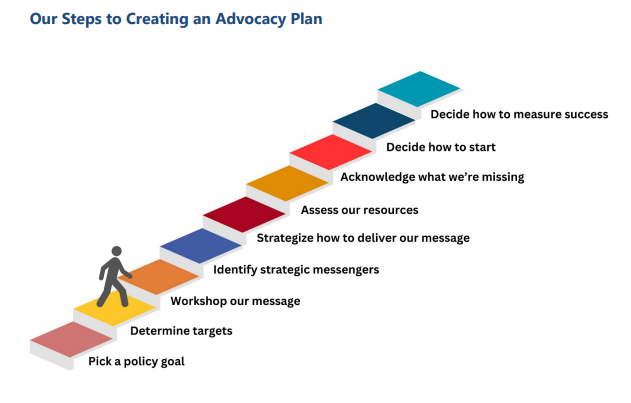
Through CDPP, we were able to assess the merit of a national nonprofit practicing direct, place-based community engagement. We found that direct connections to national nonprofits can provide value to community members through professional development opportunities, access to people in positions of systemic power, and resources to sustain their advocacy. Place-based projects led by a national organization can expand the tools available to local groups to make large-scale policy change. The value that national organizations can provide community members, however, can be stunted by long-standing norms within nonprofits and philanthropy. This report argues that the individual actions of nonprofit staff can only go so far to ensure meaningful community engagement. The entire system underpinning nonprofit advocacy needs reform to sustain staffs’ efforts to create valuable experiences for community members that inspire them to continue fighting for important policy changes.
CLASP President and Executive Director Indivar Dutta-Gupta testified to the Senate Finance Committee’s Subcommittee on Taxation and Oversight about the Child Tax Credit, its history and track record, and what Congress should do now.
Read Dutta-Gupta’s response to a Question for the Record from the hearing here.
Watch the oral testimony below:
>>Watch the full hearing here.
By Sean Ericson
(Excerpt)
“Once you start to get into the reasons why people aren’t able to access these benefits, oftentimes, it’s not because they’re ineligible. It’s because they can’t find the information they need; they’re not sure if they’re eligible and they’re afraid of some sort of negative consequence if they apply and are rejected,” said Juliana Zhou, a policy analyst at the Center for Law and Social Policy, a liberal research and advocacy group. “That’s often the case with immigrant communities, so they just won’t chance it.”
Read the full article.
By Washington Journal
In case you missed it, CLASP President and Executive Director Indivar Dutta-Gupta appeared on C-SPAN’s Washington Journal this morning for a 45-minute segment exploring key components of the Inflation Reduction Act that support people with low incomes and communities of color. He also addressed the urgent need for Congress to act on policies like the expanded Child Tax Credit, paid family and medical leave, employment programs for young people, expansion of Medicaid, child care and other care programs, those that address the student debt crisis, and more.
By Helaine Olen
(Excerpt)
Two recently released reports — one from the Brookings Institution, the other from the Center for Law and Social Policy — show how transformative the expanded child tax credit, passed as part of President Biden’s American Rescue Plan in the late winter of last year, was for millions of American families, providing not just money but security on multiple fronts.
Read the full article here.
By Parker Gilkesson
Public benefits fraud committed by people experiencing poverty is quite rare. For example, in the Supplemental Nutrition Assistance Program (SNAP), the federal government has found an overpayment rate of only 0.1 percent, or just a dime for every $100. I was invited to testify before the U.S. House of Representatives’ Subcommittee on Government Operations in a March 31 hearing on “Tackling Improper Payments for more Equitable Service Delivery.” During the hearing, other experts raised concerns that state agencies aren’t prioritizing improper payments. However, my experience as a caseworker has only underscored that we have this all wrong.
The reality is that despite the rarity of fraud, legislators and state agencies DO prioritize fraud prevention. But last month’s hearing made clear that states are looking for fraud in all the wrong places.
One of the other experts at the hearing, Linda Miller who focuses on fraud risk management, discussed how the main actors in fraud, particularly in unemployment benefits, are international rings, cyber security hackers, and identity theft operations from other countries. These entities are stealing the identities of people dead or alive to apply for benefits. But none of these actors are individuals experiencing poverty. However, all current fraud prevention measures that states use specifically target individuals.
There are millions of dollars in grants and targeted funding for fraud prevention and “program integrity.” SNAP and other benefit programs have rigorous application and eligibility processes, and caseworkers are often better trained to look for fraud than to provide trauma-informed care or to refer families to critical assistance addressing the many challenges of living in poverty. I know from my experience that caseworkers are very likely to be penalized or threatened with losing their jobs for accidentally approving recipients for more benefits than they are eligible for. Yet they aren’t penalized for denying or shortchanging benefits to eligible people.
By Ashley Burnside
People with disabilities are critical members of our communities. They are students, workers, and parents. They have jobs and hobbies, and just like anyone else, they want to live in their own homes near their loved ones. But our healthcare system does not make this easy to do for people who need supports in completing daily activities, like getting dressed, bathing, or taking their medication. Not all people with disabilities need this kind of support, but for those who do, having direct service providers who can come to their home to help them engage in those kinds of activities allows them to live in their communities with dignity, rather than only having options of living in institutional care settings.
This kind of support can be provided through home and community-based services (HCBS) under Medicaid. For people living with disabilities, HCBS provides long-term services and supports in the individual’s home, rather than in institutional settings. Providing these services to people in their own homes and communities can reduce social isolation for people with disabilities and is also cheaper than receiving such care in institutional settings. But HCBS is extremely underfunded and not available to everyone who needs it.
Medicaid provides access to institutional long-term services and supports as a mandatory benefit, but HCBS services are an optional benefit. This means it is largely up to states to decide who they provide HCBS services to, rather than ensuring it is available for all individuals who need it. Almost 850,000 people with disabilities have been left on waiting lists, sometimes for close to a decade, trying to access the HCBS services that they need.
Demand for HCBS was already high before the COVID-19 pandemic, and the rising healthcare needs stemming from the disease increased demand even more. When people with disabilities are forced to wait for their HCBS services, their loved ones may have to cut work hours to provide such care for their family member, or they may be forced to live in an institution rather than in their community. This Medicaid HCBS policy is outdated, ableist, and doesn’t meet the needs of our community members with disabilities.
Access to HCBS supports should be a guaranteed service for people with disabilities who need it – not an option that the lucky few can receive after years on a wait list. This is especially urgent following the COVID-19 public health crisis, which disproportionately impacted residents and staff at nursing homes and other long-term congregate care facilities (such as assisted living facilities). More than 30 percent of COVID-19 deaths nationally have been among residents or staff in such institutions. Living at home reduces the risk of mass disease transmission among people with disabilities and healthcare workers. The health, independence, and happiness of people with disabilities and their loved ones are improved when they have accessible HCBS options.
Providing increased funding towards HCBS services also benefits family members of those with disabilities and the direct care service professionals who help individuals with disabilities complete daily tasks, like bathing and preparing food. Direct care workers are underpaid, and face high rates of turnover. The average wage for these workers is less than $11.52 per hour, despite the essential care they provide for people with disabilities. Direct care workers are disproportionately women and people of color, meaning they already face a significant wage gap and unequal access to wealth. When direct care workers have high turnover rates, the care needs will likely fall on the family members of individuals with disabilities. Increasing the wages for direct care workers is essential to promoting wage equity, valuing the contributions of care workers, and supporting people with disabilities.
Congress should include additional funding for HCBS services in the economic reconciliation package as one way to invest in people with disabilities and to bolster the care economy. This should be in addition to other investments that support people with disabilities, and other investments towards family care. The House-passed version of the Build Back Better Act included $150 billion in funding for HCBS services, which is a positive step in the right direction. President Biden and the administration should continue to advocate for the importance of HCBS investments for people with disabilities. We are all better off when we make these investments in home and community-based services (HCBS).