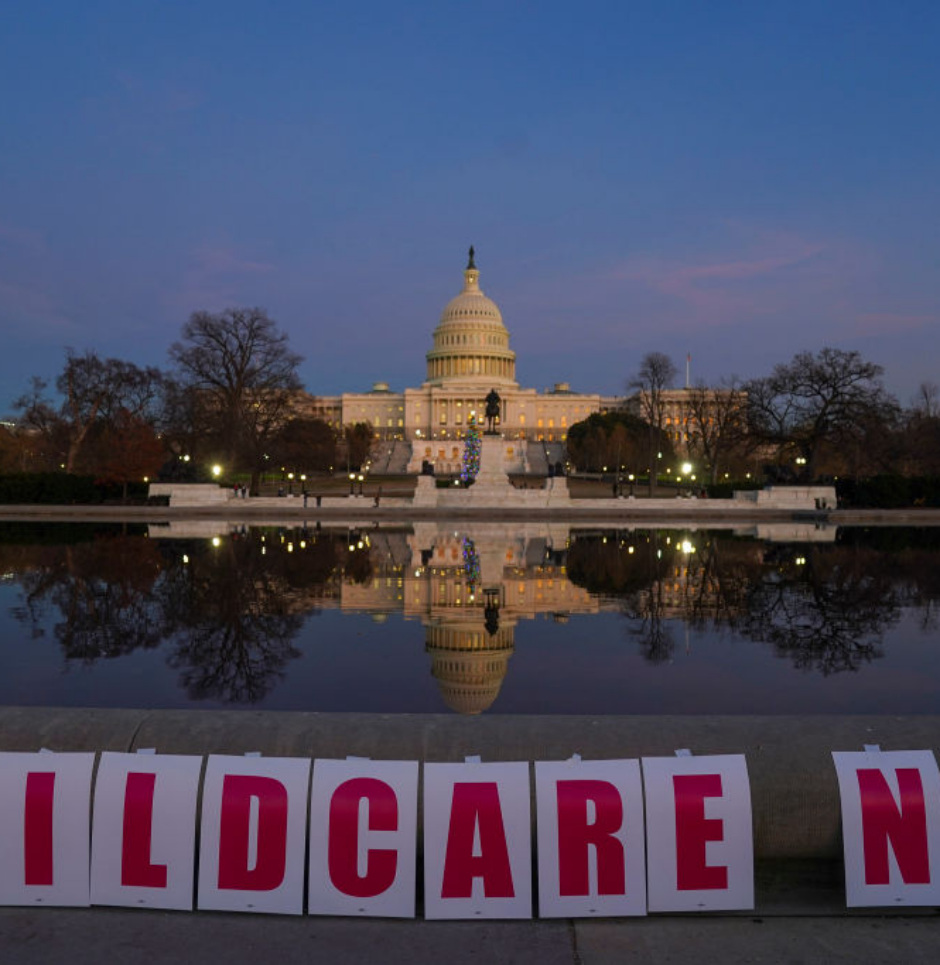
WASHINGTON, DC - DECEMBER 14: Childcare Now is spelled out on signs during Child Care Providers and Parents Rally to Pass Build Back Better at the U.S. Capitol on December 14, 2021 in Washington, DC. 50 years after President Nixon vetoed child care legislation, parents and providers rally to ensure child care is passed through Build Back Better. (Photo by Leigh Vogel/Getty Images for Child Care For Every Family Network)
CLASP has been engaging with partners through the Child Care for Every Family Network for many years to develop a strong foundation for universal child care rooted in a commitment to learning from one another's perspectives and expertise, supporting all families, centering those with diverse…
The Supreme Court of the United States recently issued its highly anticipated ruling in Fisher v Texas, upholding the constitutionality of the University of Texas’ race-conscious admissions practice.
Effective July 1, Arizona will lower its lifetime limit on receipt of cash assistance under the Temporary Assistance for Needy Families (TANF) block grant to just 12 months, the shortest in the nation.
On June 30, 2016, the U.S. Departments of Labor (DOL) and Education (ED) released final regulations to implement the Workforce Innovation and Opportunity Act (WIOA).
Medicaid was back in the news recently, in large part because of two proposals that would be significant steps backwards for the critical safety-net program that provides affordable health insurance to more than 70 million Americans.
The U.S. Department of Education selected 67 colleges and universities to serve as partners for the Second Chance Pell Program. These pilot partnerships, which include both two- and four-year schools, will enroll nearly 12,000 incarcerated students from more than 141 federal and state correctional institutions.
Restricting broadband and mobile phone access in the Lifeline program would hurt low-income families in connecting to resources that aid in employment, healthcare, e-commerce, education and civic participation.
U.S. House Speaker Paul Ryan (R-WI) acknowledged the effects of poverty on too many Americans yet offered the wrong solutions. Instead of building on what works—such as the Earned Income Tax Credit (EITC), expanded Head Start and child care subsidies, and nutritional assistance—the policy paper…
On June 2, 2016, the U.S. Departments of Health and Human Services (HHS) and Education (ED) released a joint statement, and corresponding toolkit, to support early childhood programs, states, and tribal communities in promoting the development and education of young dual language learners (DLLs)—children who come from…