Congress Is Weaponizing Federal Law Against College Athletes By Cutting Pell Grant Access and Stripping Labor Protections
By Christian Collins
The Student Compensation and Opportunity through Rights and Endorsements (SCORE) Act, H.R.4312, is a prominent example of the dangers in crafting broad legislation based on outliers instead of on the common experiences of students. Though the SCORE Act is a dedicated effort from Congress to punish college athletes for seeking the ability to be compensated for the labor they provide, this is not the first bill this year to directly target college athletes. H.R. 1, the reconciliation bill passed in July, includes a provision that removes Pell grant eligibility for any student receiving non-federal aid that equals or exceeds their full cost of attendance. This means that starting in fall 2026, every full-ride scholarship athlete across all college sports will be ineligible for Pell Grants:
“(6) Exclusion.—Beginning on July 1, 2026, and not withstanding this subsection or subsection (b), a student shall not be eligible for a Federal Pell Grant under subsection (b) during any period for which the student receives grant aid from non-Federal sources, including States, institutions of higher education, or private sources, in an amount that equals or exceeds the student’s cost of attendance for such period.”
The SCORE Act and Reconciliation Bill Limit College Affordability Pathways for College Athletes
For schools that opted into the House v. NCAA settlement, NCAA Division 1 level sports are now all treated as “equivalency” sports regarding the financial aid offers given to athletes. The term “equivalency” means that scholarships are allowed to be divided into partial scholarships split among multiple athletes. Prior to the settlement, six sports were deemed as “headcount” sports where only full-ride scholarships could be allocated: football and basketball for men’s programs, and basketball, volleyball, tennis, and gymnastics for women’s programs.
Fifty-four institutions decided not to opt into the House settlement, which means that the old system of “headcount” versus “equivalency” sports remains in place. But beginning next year, every football and men’s basketball player attending one of those 54 institutions will lose Pell Grant eligibility. For the nation’s remaining 311 Division 1 institutions, as of fall 2026, their athletes will have to choose between receiving a full athletic scholarship or having access to Pell Grants.
The Impact of this Pell Grant Provision Will Disproportionately Affect Black Men
Access to Pell Grants, even for students who receive full scholarships through athletics, is critical for students with lower incomes to fund out-of-classroom expenses not covered by scholarships, including transportation, child care, and classroom supplies.
This provision is almost surgically targeted at Black male students who participate in athletics due to the rates that they qualify for Pell Grants compared to other demographics. From the latest National Postsecondary Student Aid Survey data, nearly 69 percent of Black male college athletes on athletic scholarship received Pell Grant awards, compared to 53 percent of all Black male students and just 36 percent of all college athletes. Football and men’s basketball, the former two “headcount” sports which have the historical precedent of athletes being offered full-ride scholarships to participate in those programs and are the highest-revenue generating programs among all college sports, are represented by majorities and pluralities, respectively, of Black men.
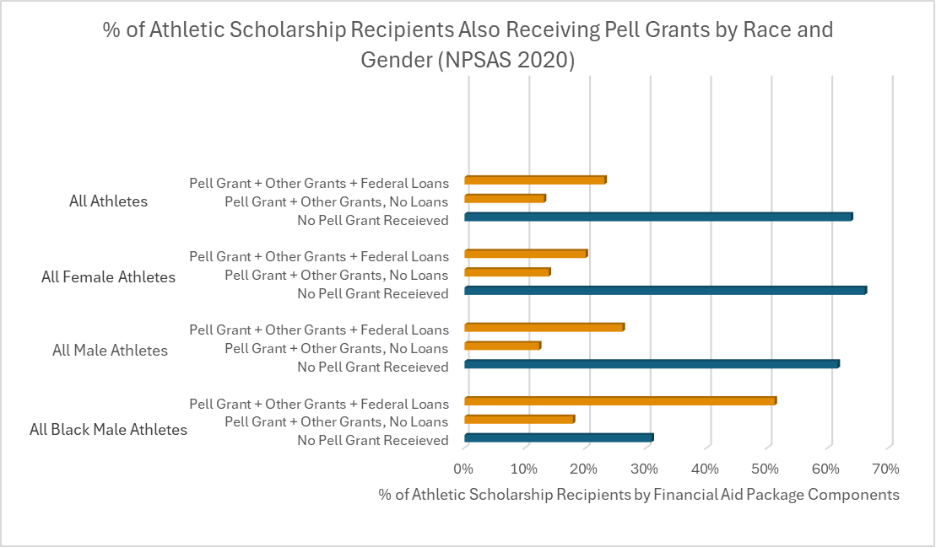 In their rush to guarantee the ability of institutions and third parties to profit off the labor of college athletes without consequence, the authors of the SCORE Act are sandwiching primarily Black male students into a cost-of-attendance trap. These athletes will now be forced to use revenue share payments and name, image, and likeness (NIL) deals to make up for losing Pell Grant dollars. Revenue share payments are currently capped, with schools also refusing to share publicly how much athletes are receiving from these payments or if they’re receiving payments at all. NIL deals are rare for most athletes and purposefully being delayed by institutions via the College Sports Commission, so even if athletes successfully land a deal, there’s no guarantee they get the money in a timely manner.
 Though the average disclosed NIL deal for Division 1 football and men’s basketball players through 2025 is $6,112, nearly 66 percent of all NIL deals for these athletes are worth $1,000 or less, which is nowhere near what athletes stand to lose in Pell Grant awards.
Fixing College Athletics Requires Giving and Taking, But Congress Is Only Taking from Students
The flawed logic behind the Pell Grant reconciliation provision—that athletes are now able to earn enough money through NIL deals and revenue sharing payments to not need Pell Grants—is the exact same flawed logic behind the SCORE Act provisions that clamp down on total compensation and federal labor protections of college athletes.
Federal policymakers have two immediate pathways to reverse their present course of forcing college athletes to seek rare third-party generosity to afford cost-of-living expenses. One pathway can be exercised by the executive branch, which should provide clarity on how the Pell Grant changes within H.R. 1 will be enforced by using the upcoming negotiated rulemaking sessions led by the Accountability in Higher Education and Access through Demand-driven Workforce Pell Committee. The other is for Congress to craft legislation that truly supports athletes, which requires centering these students in the policy creation process to understand their actual circumstances.